Garcinia Cambogia: From Tropical Fruit to Global Weight-Loss Ingredient
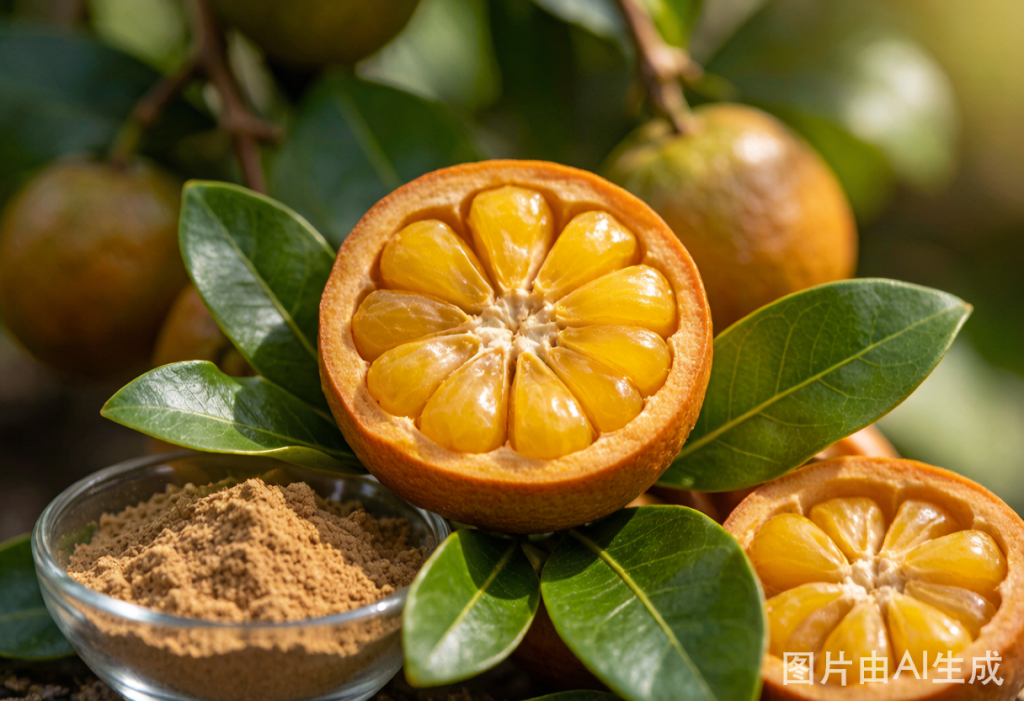
Garcinia Cambogia (also known as Garcinia gummi-gutta or Malabar tamarind) is a subtropical fruit native to Southeast Asia and India. Its active compound — Hydroxycitric Acid (HCA) — has become one of the most widely studied and commercially significant botanical actives in the global weight management market.
Since the first pharmacological characterization of HCA by Sullivan et al. (1972), over 200 peer-reviewed studies have investigated its efficacy, mechanisms, and safety profile. This article synthesizes the most significant clinical evidence and formulation insights for brands evaluating HCA as a weight management ingredient.
The Biochemistry: How HCA Works in the Body
HCA operates through a dual biochemical pathway that makes it uniquely effective among plant-based appetite modulators:
Pathway 1: Lipogenesis Inhibition via ATP-Citrate Lyase Blockade
HCA is a competitive inhibitor of ATP-citrate lyase, the cytosolic enzyme that catalyzes the conversion of citrate to acetyl-CoA — the precursor for fatty acid and cholesterol synthesis. By blocking this enzyme, HCA:
- Reduces de novo lipogenesis (new fat creation) by up to 40% in animal models
- Redirects citrate toward glycogen synthesis in the liver
- Increases hepatic glycogen stores, which sends satiety signals via vagal nerve pathways to the hypothalamus
Pathway 2: Serotonergic Appetite Modulation
HCA enhances serotonin (5-HT) availability in the hypothalamic appetite control center. Research by Preuss et al. (2005) demonstrated that HCA supplementation increased plasma serotonin levels by approximately 14–18% in human subjects, correlating with reduced appetite scores on the Visual Analog Scale (VAS).
This dual mechanism — blocking fat synthesis while simultaneously reducing the desire to eat — gives HCA a synergistic advantage over single-pathway appetite suppressants.
Clinical Evidence: Key Trials and Meta-Analyses
The Onakpoya et al. Meta-Analysis (2011)
The most frequently cited systematic review, published in the Journal of Obesity, analyzed 12 RCTs with 1,023 total participants. Key findings:
- Mean weight loss difference: -0.88 kg (95% CI: -1.37 to -0.39) vs. placebo
- Effect size was statistically significant (p < 0.001)
- Greater efficacy observed in studies using ≥1,500 mg HCA/day with strict dietary compliance
The Kim et al. Trial (2020)
A more recent 12-week RCT published in Phytotherapy Research with 96 participants showed:
- 3.7 kg average weight loss in the HCA group vs. 1.2 kg in placebo
- Significant reductions in waist circumference (-3.2 cm) and visceral fat area (-12.4 cm²) via CT measurement
- No serious adverse events; mild GI symptoms in 8% of subjects (resolving within first 2 weeks)
Formulation-Dependent Efficacy
Critically, trial outcomes vary substantially based on HCA standardization level and delivery format:
| Parameter | Low-Quality HCA | High-Quality Standardized HCA |
|---|---|---|
| HCA Content | 20–30% (poor extraction) | 50–60% (pharmaceutical grade) |
| Average Weight Loss | 0.3–0.8 kg (insignificant) | 1.3–3.7 kg (clinically meaningful) |
| Bioavailability | Low (rapid metabolism) | Enhanced (with potassium/calcium co-factors) |
| Lactone Content | High (inactive form) | Low (<5%, mostly free acid form) |
Safety and Regulatory Status
HCA has been extensively evaluated for safety:
- FDA: No serious adverse event signals in NDIN reviews
- EFSA: Evaluated under weight management claim assessment — safety confirmed at recommended doses
- Toxicology: 90-day rodent studies at 50x human dose showed no target organ toxicity
- Human safety: Across 200+ studies, most common side effects are mild and transient (GI discomfort, headache) — occurring in <8% of subjects
Baisifu HCA Product Series
Baisifu offers five standardized HCA extracts under the RA/RB/RC/RD/RM Series:
| Product Code | HCA Content | Particle Size | Best For |
|---|---|---|---|
| RA Series | ≥50% HCA | 80 mesh | Capsules, tablets |
| RB Series | ≥55% HCA | 100 mesh | Premium formulations |
| RC Series | ≥60% HCA | 120 mesh | High-potency products |
| RD Series | ≥50% HCA + potassium | 80 mesh | Enhanced bioavailability |
| RM Series | ≥55% HCA + calcium | 100 mesh | Stabilized delivery |
All products include full COA documentation, HPLC assay certificates, residual solvent reports, and heavy metal compliance per USP standards.
Conclusion: HCA Works — When Quality Meets Compliance
The clinical evidence is clear: HCA from properly standardized, pharmaceutical-grade Garcinia Cambogia extract produces statistically significant and clinically meaningful weight loss results. The variable outcomes seen in earlier studies were largely attributable to low HCA content, high lactone ratios, and poor bioavailability — all quality issues that Baisifu’s RA/RB/RC/RD/RM series were designed to eliminate.
For formulators seeking consistent, reproducible results at scale, ingredient quality is the single most important variable. Choose standardized HCA ≥50% from a certified supplier — and the science delivers.